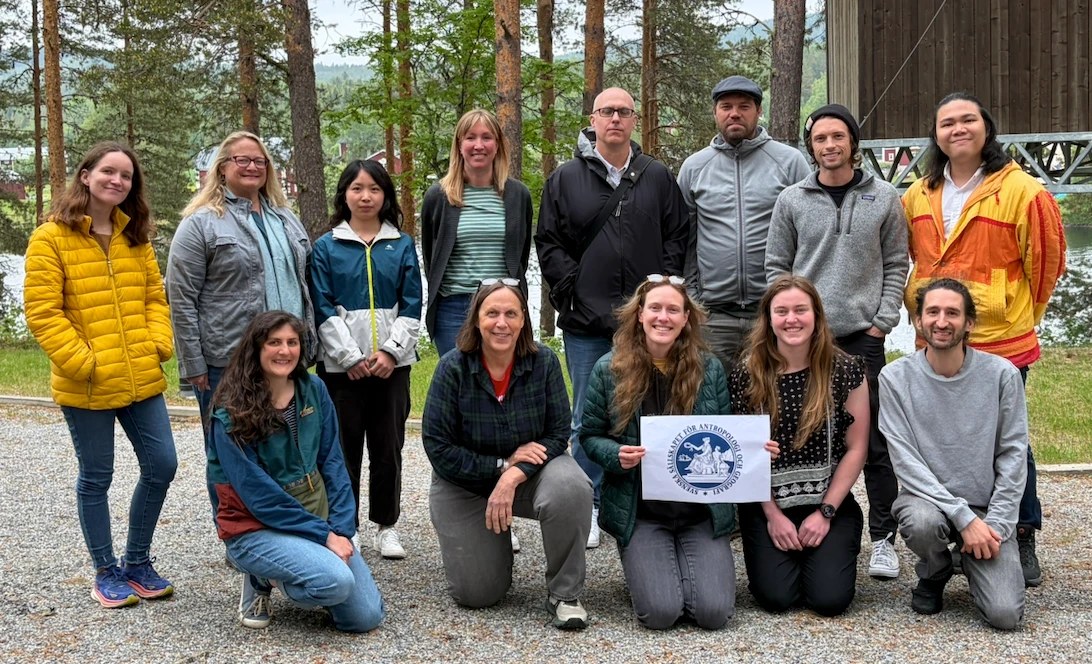
Our group organised an international workshop on drivers of methane emissions in human-impacted landscapes
In June, we gathered at Granö Beckasin with our international guests Ashley Helton (University of Connecticut), Emily Stanley (University of Wisconsin–Madison) and Ruth Varner (University of New Hampshire) to work on how human activities shape methane emissions across wet landscapes. The workshop was funded by the Swedish Society for Anthropology and Geography (SSAG).
Methane is produced by microbes in wet, low-oxygen environments, from riparian soils to streams and rivers. How much is produced depends on the supply of organic matter, but also on ions such as nitrate and sulfate, which support other microbial processes and are strongly shaped by past and present human activities. How these human impacts change methane cycling across landscapes is still poorly understood.
Building on our global data syntheses of methane in rivers and riparian soils, senior scientists and early-career researchers from our groups spent three days at Granö Beckasin developing new research articles on these questions. Many thanks to SSAG for making this workshop possible!